
THE LEADERSHIP GAP NO ONE IS TALKING ABOUT
A.H.E.A.D. 2.0
We trained leaders for teams made of people. The team has changed.
A.H.E.A.D. 2.0 is a leadership capability program for the AI era not technology training, not another change framework, but a fundamentally new set of capabilities for leading when your team includes machines that sound like colleagues but have no stake in the outcome.
Apply for A.H.E.A.D. 2.0WHY THIS MATTERS NOW
AI doesn't just change the work.
It changes how leaders need to lead.
85% of organizations have adopted AI. Less than 1 in 5 can show a measurable return. The technology works. How organizations equip themselves doesn't.
The reason isn’t technical. It’s that the people steering these transformations were never equipped for what AI actually demands.
AI doesn’t ask leaders to learn a new tool. It asks them to rethink what decisions belong to humans, what work has meaning, how trust is built when a system makes choices no one fully understands, and how to hold an organization steady when the ground shifts every quarter.
That is not a training gap. That is a leadership gap.
Apply for A.H.E.A.D. 2.0
THE REAL ISSUES
What's Actually Happening Inside Your Organization?
- AI adoption is funded, but human readiness is not, and adoption is stalling
- Middle managers are overwhelmed and disengaging from change leadership
- Employee trust has eroded after rounds of layoffs and contradictory messaging
- Multiple concurrent transformations are creating fatigue; people are maxed out
- Change success is measured by project milestones, not human capacity shifts
- Current frameworks feel one-dimensional, skipping relationships and inner readiness
THE A.H.E.A.D. FRAMEWORK
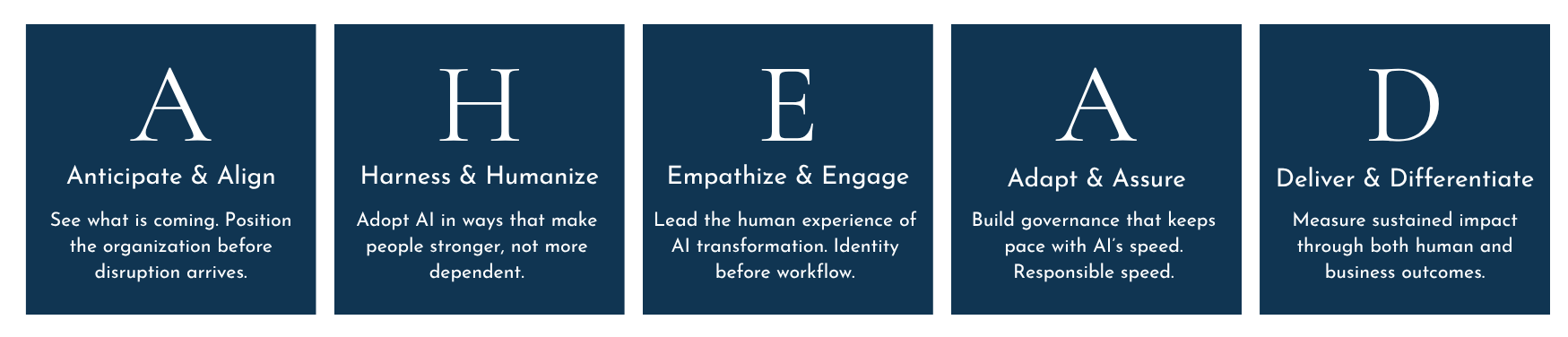
Five capabilities for leading when the team includes machines.
A.H.E.A.D. stands for five leadership capabilities that, taken together, represent what it means to lead well in the AI era. They are sequential in logic but cyclical in practice. No organization completes them once.
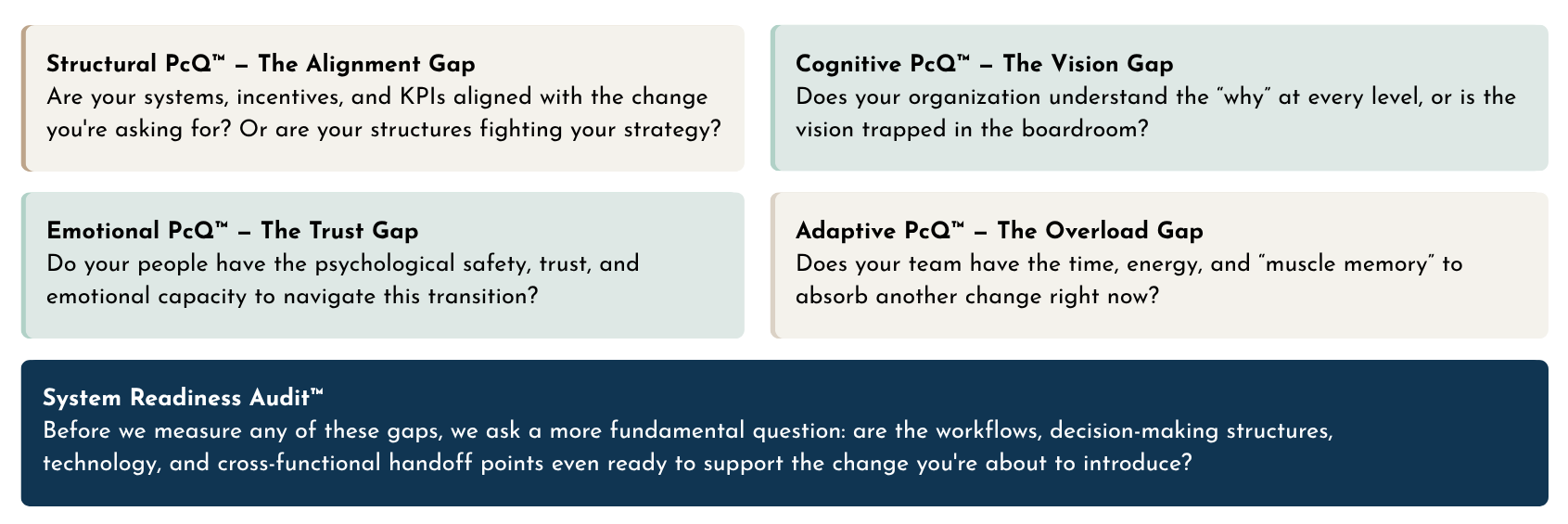
Powered by Four Dimensions of PcQ™ + System Readiness Audit™
THE SIX CHALLENGES
There are no precedents set for leading with AI.

01
Trust Calibration
AI sounds confident whether right or wrong.
02
Cognitive Sovereignty
03
Accountability Design
Who owns outcomes from human-AI chains?
04
Asymmetric Relationships
People bond with systems that don't reciprocate.
05
Speed Inequity
AI fluency drowns out contextual judgment.
06
Identity Transition
When AI does the work, what is a leader for?
WHAT THIS IS NOT
Let’s be clear about what A.H.E.A.D. 2.0 is not.
It is not a technology adoption framework. It does not teach leaders how to use AI tools, evaluate vendors, or build data strategies. There is no shortage of those.
It is not a change management methodology applied to AI. It does not layer familiar project phases on top of a fundamentally new challenge and call it solved.
And it is not a set of principles to hang on a wall.
Principles without practice are decoration.
A.H.E.A.D. 2.0 is a leadership capability model for organizations where AI is no longer a project but a permanent condition.
Apply for A.H.E.A.D. 2.0HOW THE PROGRAM WORKS
Six sessions. A leadership shift that lasts.
Delivery is hybrid (in-person or virtual). Cadence is flexible, weekly, bi-weekly, or monthly, depending on your organization’s rhythm.
Each session opens with a hybrid team lens that connects the capability to the specific reality of leading teams that include AI agents.
SESSION 0 - ORIENTATION & DIAGNOSTIC
Asynchronous pre-work (30–45 min). Complete the A.H.E.A.D. 2.0 self-assessment. Generate your personal leadership profile. Begin reflecting on how AI is affecting your context.
SESSION 1 - ANTICIPATE & ALIGN
Develop foresight and ethical clarity. Learn to distinguish AI signals that require strategic action from noise that distracts. Build your AI Opportunity-Risk Map.
SESSION 2 - HARNESS & HUMANIZE
Design human-AI partnerships that build capability, not dependency. Define decision boundaries. Confront the cognitive sovereignty challenge. Build a Delegation Architecture.
SESSION 3 - EMPATHIZE & ENGAGE
Lead the emotional and identity dimensions of AI transformation. Address asymmetric relationships with AI. Build an Empathy Response Blueprint for your team.
SESSION 4 - ADAPT & ASSURE
Build adaptive governance for human-AI decision chains. Design accountability structures, escalation protocols, and trust calibration practices.
SESSION 5 - DELIVER & DIFFERENTIATE + INTEGRATE
Measure sustained impact. Assess capability vs. dependency. Build your personal AI Leadership Development Plan. Integrate all five capabilities into a coherent leadership practice.
SESSION 6 - INTEGRATION AND PcQ™ CAPSTONE
Step back and see the whole. Not just what you have learned, but what your organization’s capacity to absorb this change actually looks like, and what you are going to do about it.
IDEAL CLIENT PROFILE
Built for Leaders Who Know
the Old Playbook Is Failing.
A.H.E.A.D. 2.0 is not for everyone. It is specifically designed for organizations and leaders navigating high-stakes transformation who are tired of frameworks that look good on slides and fail in reality.

CHROs & Heads of OD / Transformation
You own the people side of change but your budget keeps going to tech. You are watching fatigue build and trust erode, and the legacy change models your team is using were designed for a world that no longer exists.
Senior Change Leaders & VPs of Strategy
You are leading AI transformation, restructuring, or culture shifts across multiple business units. You have seen the knowing-doing gap up close: everyone agrees on what needs to change, nobody sustains the behaviour shift.
Internal & Consulting Practices
You need a differentiated methodology that goes beyond ADKAR and Kotter. Your clients are asking for human-centred, AI-aware change approaches and your current toolkit does not deliver that.
PROGRAM OUTCOMES
Your people leave with knowledge & capability.
By the end of A.H.E.A.D. 2.0, participants will be able to:
01
Scan for and interpret AI-driven disruption, including agentic AI, regulatory shifts, and workforce structural change
02
Design human-AI workflows that build capability rather than dependency, with clear decision boundaries and accountability structures
03
Lead the emotional and identity dimensions of AI transformation, including the dynamics of working alongside systems that have no stake
04
Build adaptive governance frameworks with runtime monitoring, escalation protocols, and accountability design for human-AI decision chains
05
Measure AI impact using both performance and human outcomes, and assess the capability-to-dependency ratio across their teams
06
Calibrate trust with AI systems, maintain cognitive sovereignty in their teams, and manage the speed and power inequities AI creates

Each participant also receives:
- A personal A.H.E.A.D. 2.0 leadership profile (from the pre-work diagnostic)
- A complete participant workbook with exercises, scenarios, and reflection tools
- All session materials, templates, and frameworks
- A post-program AI Leadership Development Plan ready for immediate application
Start with What Is Actually True
About Your Organization
Every A.H.E.A.D. 2.0 engagement begins with an honest read. Book a PcQ™ Discovery Call and find out what your change capacity really looks like, before your next transformation burns through it.
Complete the application form below. Once complete, you will be guided to book a consultation to ensure fit.