THE PcQ™ FRAMEWORK
The capacity indicator that determines whether everything else you invest in actually delivers.
(PcQ™) measures and builds an organization's human capacity to take on, lead, and sustain change. Not to endure it. To be strengthened by it.
LEARN MORE
THE EVOLUTION
IQ measures the person. EQ measures the leader. PcQ™ measures the system.
IQ
ASSESSES
Can this person think?
EQ
ASSESSES
Can this person feel, connect, and lead?
PcQ™
ASSESSES
Can this organization grow stronger through the changes it faces?

THE FOCUS
The missing intelligence that changes everything.
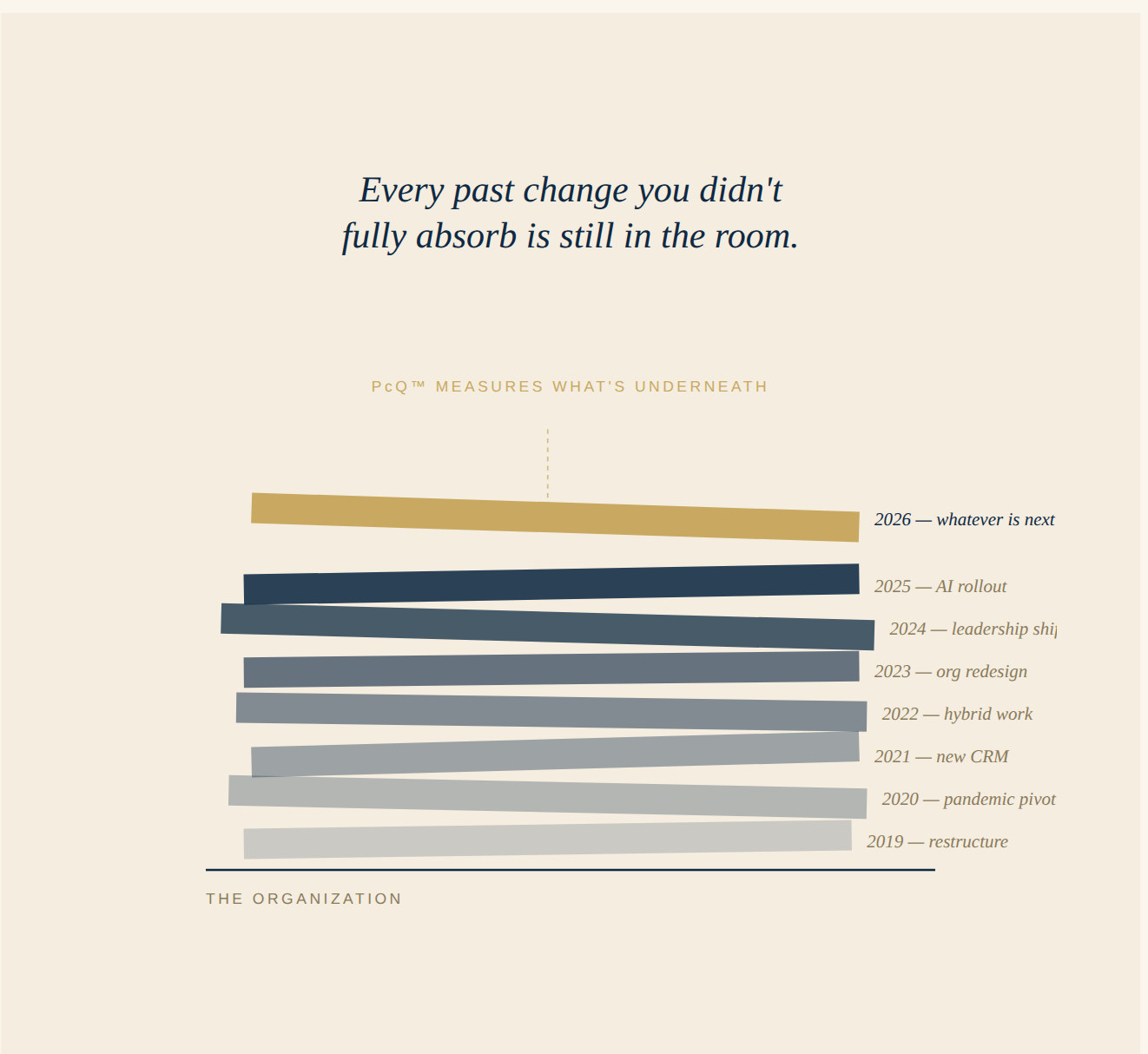
"Every change either builds capacity or organizational debt. PcQ™ measures which one."
You can have a workforce of highly intelligent, emotionally attuned professionals. But if the incentive structures reward the old behaviour, if the "why" behind the change is trapped in the boardroom, if trust has been eroded by three previous failed transformations, and if the team has no bandwidth left to take on another initiative, the change will fail.
Not because of the people. Because the organization never built the capacity for change to land.
PcQ™ is not a personality assessment. It is not an engagement score. It measures the relationship between people and the systems they work inside — across four dimensions. Each one mapped to a specific organizational gap. Each one is developable.
What is People Change Capacity (PcQ™)?
People Change Capacity (PcQ™) is a measure of how much change an organization’s people can carry at one time before adoption fails or performance and wellbeing decline.
Change programs are usually assessed on the quality of the plan: the scope, the sequencing, the budget, the communications. PcQ™ assesses something the plan cannot tell you, which is whether the organization the plan is being handed to has any capacity left to receive it.
It is measured across four dimensions. Structural PcQ™ asks whether the system around people is pointing the same way the change is. Cognitive PcQ™ asks whether people understand what is being asked and what it means for their own work. Emotional PcQ™ asks whether people believe what they are being told, based on how change was handled the last time. Adaptive PcQ™ asks how much capacity is left after everything already in flight.
The four are not weighted equally against each other and they do not average out. A change can clear three dimensions comfortably and still fail on the fourth. The purpose of measuring is to find out which one is carrying the risk, before the launch date rather than after it.
PcQ™ is measured at the level of a system: an organization, a division, a function, or a change initiative. It is not a personality assessment and it does not produce individual scores.
PcQ™ is read alongside the System Readiness Audit™, which measures whether the systems people depend on can carry more change. Together the two produce the Pulse, a single view of an organization’s capacity. A PcQ™ reading taken on its own is hard to interpret, because it cannot tell you whether a low score reflects the people or the conditions they are working in.
FOUR DIMENSIONS
Four gaps that quietly determine whether change lands or drifts
Each dimension is measurable. Each is developable. And no other change framework measures all four at the system level.
The Alignment Gap
Structural PcQ™
Are your systems, incentives, and KPIs aligned with the change you're asking for, or are they actively working against it?
The strategy says "change." But the performance metrics still reward speed over accuracy, the promotion criteria still favour the old way, and the governance structures still require four levels of approval for anything new. The structure says "don't." When it is left unmeasured, every transformation is fighting its own architecture.
The Vision Gap
Cognitive PcQ™
Does your organization understand the "why" at every level, or is the vision trapped in the boardroom?
Most organizations confuse communication with comprehension. They send the email. They hold the town hall. They cascade the talking points. And then wonder why no one is behaving differently. The Vision Gap is the distance between what leadership intends and what people at every level actually understand and believe.
The Trust Gap
Emotional PcQ™
Do your people have the psychological safety, trust, and emotional capacity to navigate this transition?
When people do not feel safe, they do not resist change. They perform compliance while withholding discretionary effort, institutional knowledge, and honest feedback. This is the dimension most change frameworks skip entirely — and the one that determines whether people bring their real selves to the change or just wait it out.
DIMENSION 4
The Overload Gap
Adaptive PcQ™
Does your team have the time, energy, and adaptive capacity to take on another change right now?
Organizations almost never budget for adaptive capacity. Teams are running at near-full capacity before the change initiative even begins. Every initiative that lands on top of an already-overloaded system consumes more energy than it produces. This is where PcQ™ reveals what no other framework measures.
The four dimensions of PcQ™, defined
Structural PcQ™, the Alignment Gap
Structural PcQ™ measures whether an organization’s structures, priorities, decision rights, and incentives point in the same direction as the change it is asking for.
When Structural PcQ™ is low, people are asked to work in a new way while everything around them still rewards the old one. They are not resisting. They are reading the system correctly.
Cognitive PcQ™, the Vision Gap
Cognitive PcQ™ measures whether people understand what the change is, why it is happening, and what it means for the specific work they do on a Tuesday morning.
When Cognitive PcQ™ is low, people can repeat the message back to you accurately and still be unable to act on it, because it was communicated but never translated.
Emotional PcQ™, the Trust Gap
Emotional PcQ™ measures whether people believe what they are being told and trust the people telling them. It is largely set before the current change begins, by how the last one was handled.
When Emotional PcQ™ is low, more communication does not repair it. It usually accelerates the damage, because each additional message is read as further evidence of the gap between what is said and what is done.
Adaptive PcQ™, the Overload Gap
Adaptive PcQ™ measures how much capacity people have left once everything already in flight is accounted for.
When Adaptive PcQ™ is low, the change can be well designed, clearly explained, and genuinely believed in, and it will still fail to land. There is simply nothing left to carry it with. This is the dimension most often misdiagnosed as resistance.
The PcQ™ Maturity Model
The PcQ™ Maturity Model describes how an organization’s relationship with its own change capacity develops. There are five levels.
- Aware. The organization recognises that change capacity is a real constraint rather than an excuse.
- Measured. Capacity is assessed rather than assumed.
- Practising. Capacity data is used to make real decisions about sequencing and load.
- Embedded. Capacity is a standing input to portfolio and planning decisions, not a one off exercise.
- Generative. The organization builds capacity ahead of demand rather than in response to strain.
An organization is placed at the level of its lowest scoring domain rather than its average, on the same principle that governs the System Readiness Audit™. Maturity is set by the weakest part of the system, because that is the part everything else waits for.
Before we measure any of these gaps, we ask a more fundamental question.
Are the systems your people operate in the workflows, decision-making structures, technology, and cross-functional handoff points, even ready to support the change you're about to introduce?
The System Readiness Audit™
The System Readiness Audit™ (SRA™) measures whether the systems an organization runs on can carry more change.
The SRA™ evaluates four domains. A red rating in any single domain caps the overall result, because a foundation is only as sound as its weakest point.
GETTING CURIOUS? - LET'S TALKHOW TO BUILD PEOPLE CHANGE CAPACITY
Three ways to build
People change capacity
in your organization.
02
Build
THE CHANGE CONNECTION LAB
The most complete environment for building PcQ™. Structured learning anchored to the change your organization is actually responsible for — working across executives, leaders, change roles, and teams simultaneously on your real transformation.
03
Sustain
COACHING, ADVISORY, FACILITATION & ONGOING MEASUREMENT
PcQ™ is not a workshop outcome. It is an organizational capability that strengthens over time. Ongoing coaching and PcQ™ measurement ensure the intelligence you build compounds — every change makes the next one easier.
GAIN CLARITY